
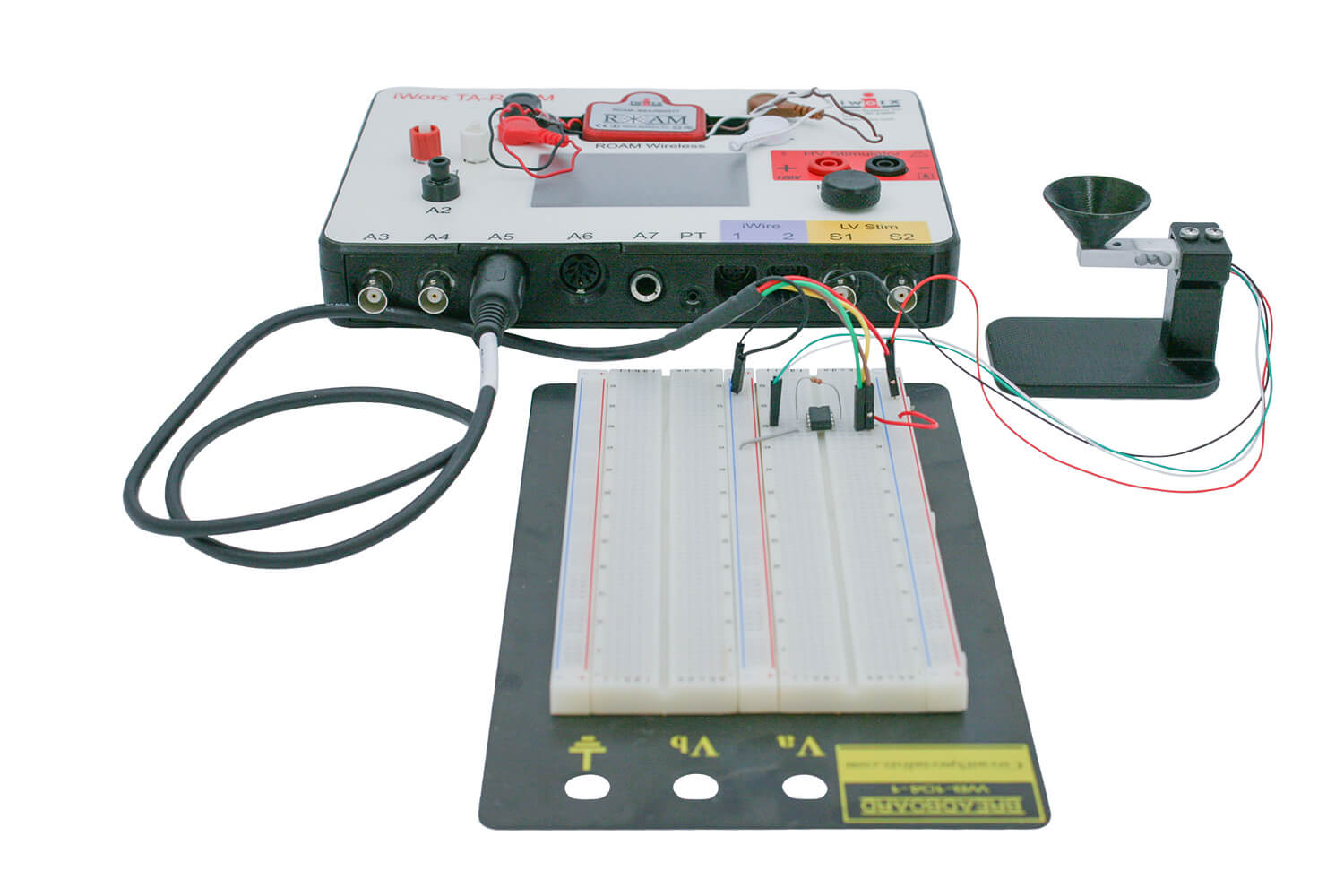
The strain gauge force transducer, a type of resistor, alters its resistance when stretched or compressed. This change in resistance, indicative of strain, is converted into a voltage signal through a resistance bridge.
Origins: The strain gauge was invented in 1938 by Edward E. Simmons and Arthur C. Ruge. It has since become a crucial tool in various fields of engineering and materials science.
Uses:
When an electrical conductor is stretched within the limits of its elasticity such that it does not break or permanently deform, it will become narrower and longer, which increases its electrical resistance end-to-end.
Conversely, when a conductor is compressed such that it does not buckle, it will broaden and shorten, which decreases its electrical resistance end-to-end. From the measured electrical resistance of the strain gauge, this amount of induced stress may be inferred. The strain gauge in this experiment is attached to an aluminum bar so that any elongation in the bar due to applied forces will cause a change in the resistance in the strain gauge. This resistance change is usually measured using a Wheatstone bridge.
An excitation voltage is applied to input leads of the Wheatstone bridge network, and a voltage reading is taken from the output leads. The typical output voltage readings are in millivolts. We will be using the instrumentation amplifier to amplify this signal and then record it with the iWorx recorder.
The main objective in this experiment is to correlate the change in voltage with the change in strain so that we can pinpoint a certain voltage change as indicative of a certain amount of force applied.
We will contact you with your login info.
By subscribing, you agree with our Privacy Policy and provide consent to receive updates from our company.