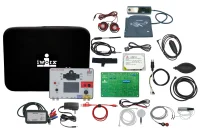
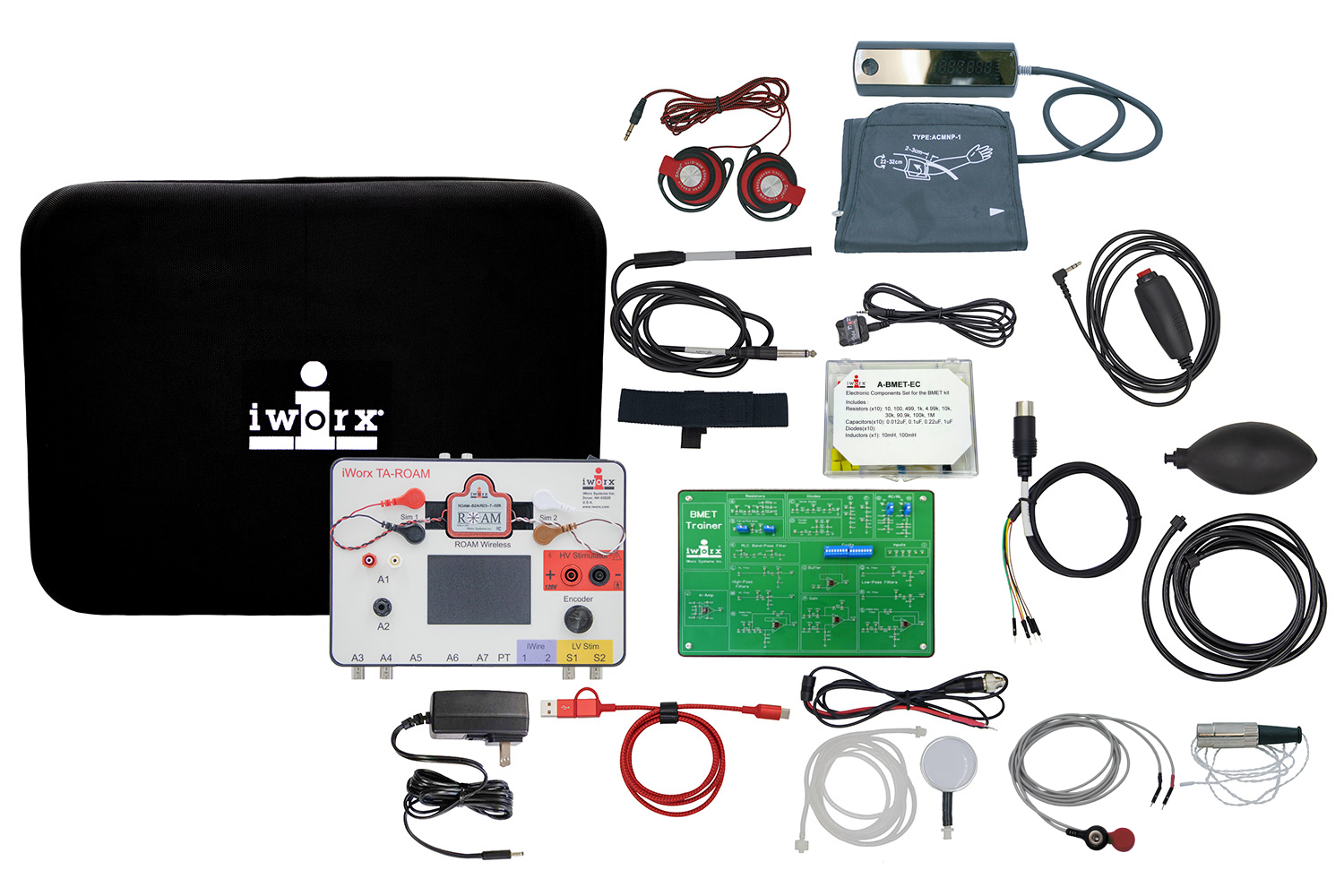
The BMET-TR is a versatile teaching system with 59* hands-on experiments covering ECG, EMG, blood pressure, pulse oximetry, nerve conduction, exercise physiology, troubleshooting, and more.
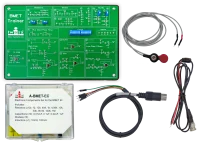
The system also includes the A-BMET-Trainer Board, designed specifically for teaching biomedical engineering technicians the fundamentals of electronics and biomedical instrumentation. Its 15 step-by-step labs cover topics such as time-varying signals, filters, amplifiers, biomedical signal filtering, and troubleshooting.
With both physiology and BMET training capabilities, the BMET-TR gives programs a flexible platform for teaching biomedical instrumentation, electronics, data acquisition, and human physiology.
BMET lab manual page.These Lab Exercises can be performed with the BMET-TR kit. These experiments support courses in Biomedical, Bioengineering, Bioinstrumentation, Signal Conditioning, Physiological systems, etc.
For lab descriptions please visit the BMET lab manual page.
For all available iWorx exercises with descriptions, please visit our lab manual page.
For lab descriptions please visit the BMET lab manual page.
For all available iWorx exercises with descriptions, please visit our lab manual page.
CBET certification logo © Association for the Advancement of Medical Instrumentation (AAMI). Use of this logo does not imply AAMI endorsement of iWorx Systems or its products.
Read our white paper on how the iWorx BMET-TR Prepares students for success in taking CBET Certification Exam.
The CBET certification validates a technician’s ability to maintain, troubleshoot, calibrate, and ensure the safety of complex medical devices in healthcare facilities. The exam evaluates candidates across six key domain areas requiring both conceptual understanding and pragmatic field capabilities.
Traditional BMET programs often separate academic instruction (anatomy, physiology, and electrical engineering theory) from clinical equipment labs. The iWorx BMET Kit closes this divide by integrating physiological signal acquisition, circuit testing, and bioinstrumentation analysis into interactive, practical laboratory exercises.
| CBET Exam Domain | Total Exam Weight | iWorx Covers | iWorx BMET Kit Practical Mapping |
|---|---|---|---|
| Anatomy & Physiology | 7% | 7% | Hands-on investigation of cardiovascular, muscular, and other physiological systems through ECG, pulse, blood pressure, EMG, nerve conduction, reflex, and exercise experiments. |
| Fundamentals of Electricity & Electronics | 6% | 3% | Analysis of fundamental electronic circuits, with labs including Ohm’s Law, series and parallel circuits, voltage dividers, semiconductors, RC/RL circuits, passive and active filters, instrumentation amplifiers, and operational amplifiers. |
| Healthcare Information Technology | 17% | 3% | Hands-on setup and troubleshooting of biomedical system hardware, including acquisition components, cables, connectors, and related hardware used to collect physiological data. |
| Healthcare Technology and Function | 30% | 14% | Operation and analysis of biomedical instrumentation used for physiological measurement, including ECG, EMG, blood pressure, pulse oximetry, and temperature. |
| Healthcare Technology Problem Solving | 30% | 8% | Hands-on troubleshooting through intentional fault insertion, signal distortion, and systematic identification and correction of faults. |
| Public Safety in Healthcare Facilities | 10% | 0% | The BMET-TR does not directly address the CBET concepts in this domain, including healthcare safety standards and regulations, infection control, CMS/accreditation, AAMI standards, or CMMS. |
| Concept | Covered by BMET-TR? |
|---|---|
| Understand the functions and basic abnormal functions of the physiological systems, including circulatory, respiratory, gastrointestinal, nervous, musculoskeletal, and endocrine systems. | Yes |
| Identify major components and the major functions of the primary organs, including the heart, lungs, brain, and skin. | Yes |
| Understand basic medical terminology. | Yes |
| Concept | Covered by BMET-TR? |
|---|---|
| Apply foundational electronic theories as they relate to voltage, resistance, current, power (Ohm's Law), and active and passive devices, including the use of schematics to troubleshoot. | Yes |
| Understand the purpose and usage of various power-conditioning, distribution, and storage systems, including LIMs, transformers, batteries, and uninterruptible power supplies (UPS). | No |
| Concept | Covered by BMET-TR? |
|---|---|
| Understand and apply protective standards and regulations for protected data, including the Health Insurance Portability and Accountability Act (HIPAA), NIST framework, HITRUST, and HHS cybersecurity performance goals. | No |
| Troubleshoot system hardware, including power supplies, peripherals, hard drives, cables, and connectors. | Yes |
| Troubleshoot, update, and patch system software, including Windows, Office, Linux, and Unix. | No |
| Troubleshoot wired and wireless networks and networking components, including routers, switches, access points, access-point controllers, KVMs, cables, virtual servers, LANs, WANs, and cloud computing, using diagnostic tools or processes such as cable tracers, PING, and networking commands. | No |
| Understand and troubleshoot the integration of medical devices directly to an EMR or through the use of middleware. | No |
| Understand basic system identifiers and terminology, including IP and MAC addresses. | No |
| Concept | Covered by BMET-TR? |
|---|---|
| Understand physiological concepts as they apply to healthcare technology, including Korotkoff sounds, Einthoven's triangle, the QRS complex, and the dicrotic notch. | Yes |
| Understand the normal function, use, and underlying technology of test equipment, including electrical safety analyzers, defibrillator analyzers, electrosurgical analyzers, physiological simulators, digital voltmeters, and meters. | No |
| Understand physiological measurements and their applications, including mmHg, PSI, bar, degrees Fahrenheit, cm H2O, lumens, and joules. | Yes |
| Understand the normal function of monitoring systems, including fetal monitors, telemetry systems, physiological monitors, and vital-signs monitors. | Yes |
| Understand the normal function and underlying technology of monitoring parameters, including EtCO2, ECG, EEG, NIBP, IBP, oximetry, TOCO, FHR, respiration, and temperature. | Yes |
| Understand the normal function and underlying technology of diagnostic equipment, including otoscopes, ophthalmoscopes, scales, stress-test systems, audiometers, ECG systems, spirometers, and ultrasound equipment. | Yes |
| Understand the normal function and underlying technology of infusion equipment, including feeding pumps, large-volume pumps (LVPs), syringe pumps, patient-controlled analgesia (PCA) pumps, and injectors. | No |
| Understand the normal function and underlying technology of therapeutic equipment, including neonatal and pediatric equipment, patient-temperature-management equipment, aspiration equipment, sequential compression devices (SCDs), and physical-therapy equipment. | No |
| Understand the normal function and underlying technology of perioperative equipment, including electrosurgical units (ESUs), video-integration equipment, tourniquets, sterilization equipment, fluid warmers, tables, lights, and surgical microscopes. | No |
| Understand the normal function and underlying technology of life-support equipment, including defibrillators, anesthesia machines, ventilators, balloon pumps, and external pacemakers. | No |
| Understand the normal function of laboratory equipment, including centrifuges, incubators, rockers, refrigerators, freezers, microscopes, water baths, analyzers, cryostats, and microtomes. | No |
| Concept | Covered by BMET-TR? |
|---|---|
| Identify and resolve fault conditions in modules and subsystems, including power supplies. | Yes |
| Prioritize repairs of medical devices based on risk, urgency, and potential downtime. | No |
| Differentiate between a device error and a use error to determine the appropriate action. | No |
| Provide education to staff on the proper use of equipment and communicate effectively, verbally and in writing, with clinicians, other hospital personnel, and manufacturers about technical issues and projects, including in-service training and cross-training. | No |
| Differentiate between an issue with a localized monitoring device on a network and a system-wide problem. | No |
| Identify fault conditions and apply appropriate corrective action for monitoring systems, including fetal monitors, telemetry systems, physiological monitors, and vital-signs monitors. | Yes |
| Identify fault conditions and apply appropriate corrective action for diagnostic equipment, including otoscopes, ophthalmoscopes, scales, stress-test systems, audiometers, ECG systems, and spirometers. | Yes |
| Identify fault conditions and apply appropriate corrective action for infusion equipment, including feeding pumps, large-volume pumps (LVPs), syringe pumps, patient-controlled analgesia (PCA) pumps, and injectors. | No |
| Identify fault conditions and apply appropriate corrective action for therapeutic equipment, including neonatal and pediatric equipment, patient-temperature-management equipment, aspiration equipment, sequential compression devices (SCDs), and physical-therapy equipment. | No |
| Identify fault conditions and apply appropriate corrective action for perioperative equipment, including electrosurgical units (ESUs), video-integration equipment, tourniquets, sterilization equipment, fluid warmers, tables, lights, and surgical microscopes. | No |
| Identify fault conditions and apply appropriate corrective action for laboratory equipment, including centrifuges, incubators, rockers, refrigerators, freezers, microscopes, water baths, analyzers, cryostats, and microtomes. | No |
| Concept | Covered by BMET-TR? |
|---|---|
| Understand electrical safety requirements under NFPA 99 and IEC 60601 for the use of medical equipment, including microshock, macroshock, power-cord color coding, GFCI protection, and electrical safety limits. | No |
| Understand the use of safety data sheets and identify standard hazard symbols and signage, including those for lasers, MRI, ionizing radiation, and patient precautions. | No |
| Understand universal precautions and determine appropriate infection-control procedures and proper use of personal protective equipment (PPE). | No |
| Understand the role and function of CMS and the organizations authorized to provide accreditation on behalf of CMS. | No |
| Understand ANSI/AAMI standards, including EQ56 (medical equipment programs), EQ89 (scheduled maintenance and performance), EQ93 (medical equipment vocabulary), and EQ103 (alternative equipment maintenance). | No |
| Understand how to efficiently navigate and use a computerized maintenance management system (CMMS) to document maintenance activities, track equipment history, and generate reports for compliance and performance analysis. | No |

This kit includes everything you need to build your own force transducer.

5k Force Transducer, laser interrupt sensors, Magnetic Field Sensor,

Conductivity Sensor, Colorimeter and Turbidity Sensor, Drop Counter, Humidity Sensor, Dissolved Oxygen Electrode, Ph Electrode
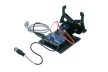
A-CLAW is an Arduino controlled claw.
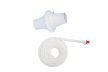
300 Liter flow head for spirometry with tubing

O2/CO2 Analyzer, 1000L Flow Head, Re-Usable Head Gear and Face Mask, Non-Re-Breathing Valve Assembly, 5 L Mixing Chamber, Clean Bore Tubing, Scosche HR

Respiration Monitor, GSR Electrodes, EEG Headband, Foot Reaction Switch, Bi-Polar Light Source

pH Probe, Conductivity Meter, O2 Electrode, Respiration/Photosynthesis Chamber, Osmosis and Diffusion Chamber
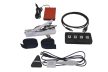
Goniometer, 4 button Response pad, Patella Reflex Hammer, Bi-Color Light Source, Foot Reaction Switch

Intracellular Probe , Nerve Bath Chamber, Suction Electrode, Hook Electrode, Needle Electrodes, Suction Electrode, Reflex Hammer, Goniometer, Flexible Silver Wire Electrodes

Force Transducer, Nerve Bath Chamber, O2 Electrode, platinum stimulating and recording electrodes

Force Transducer, Nerve Bath Chamber, platinum stimulating and recording electrodes, Flexible Silver Wire Electrodes, Dissection Kit

Includes NMD-EAR, NMD-EYE and Spike Sorting Analysis Module

The REACH-DL is a home-based lab kit designed for distance learning and online students
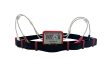
The A-HB-ROAM EEG headband is designed to provide long-term recording and unrestricted movement when worn and connected to the ROAM-B2A.
The iWorx team is here to help—whether you have a quick question or need hands-on support. Our technical specialists offer one-on-one assistance with setup, troubleshooting, and optimizing your system.
We will contact you with your login info.
By subscribing, you agree with our Privacy Policy and provide consent to receive updates from our company.