

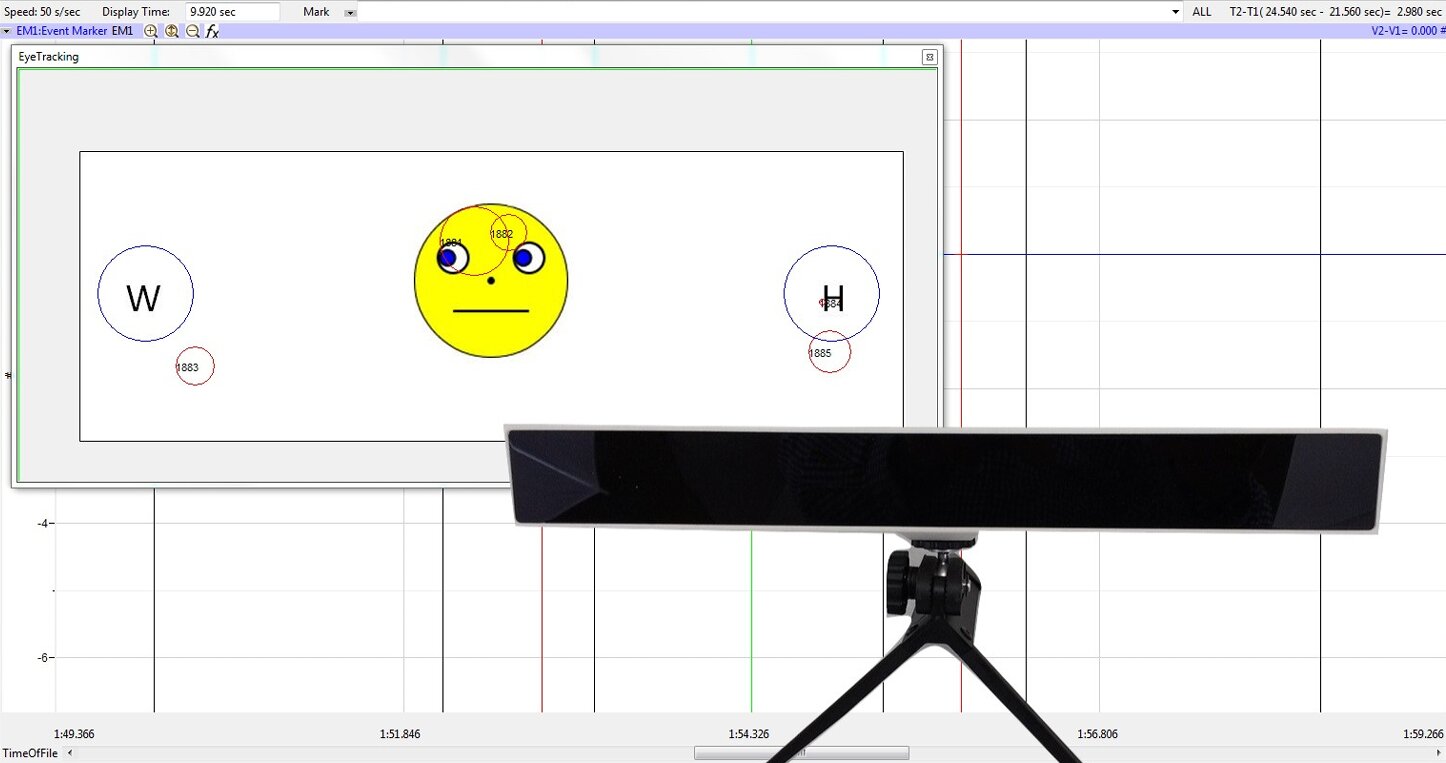
Eye tracking is a powerful method for understanding how people read, search, and make decisions. By measuring where someone looks, how long they look, and how their eyes move, researchers gain insight into attention, comprehension, and cognitive processing.
Modern systems use cameras, infrared illumination, and mathematical models to estimate gaze direction with high precision.
Key Eye-Tracking Concepts
Fixations: Fixations are brief pauses when the eyes stop moving and take in information and represent moments of actual visual processing. They reveal attention, comprehension, and cognitive load, but only last between 100-400 msec.
Saccades: Saccades are rapid jumps between fixations which can reach speeds up to 500°/s. Vision is briefly suppressed during the movement (saccadic suppression). Saccades show how people scan or search through information.
Areas of Interest (AOIs): AOIs are researcher‐defined regions on a screen or image used to organize gaze data. They can be rectangles, polygons, or dynamic regions. These enable metrics such as:
- Time to first fixation
- Total fixation duration
- Number of revisits
- Scan paths between AOIs
How the iTrax Eye Tracker Works
The iTrax unit sits below the monitor and uses infrared (IR) illumination, cameras, geometric models, and calibration map to track eye position.

This system allows exploration into how eye movements reflect cognitive processes in real time, including:
- Being able to explain how eye movements index cognitive processes during reading, including difficulty and attention;
- Connect eye‐tracking metrics (fixations, saccades, AOIs) to theories of language processing and cognitive load; and
- Design capstone research experiments to collect eye‐tracking and behavioral data, and interpret results using scientific reasoning.


