
Table of Contents
One of the biggest challenges in Biomedical Engineering (BME) and advanced physiology education is helping students bridge the gap between biological signals and mechanical execution. How do we turn a physiological event, like a muscle contraction, into a controlled action by a prosthetic device?
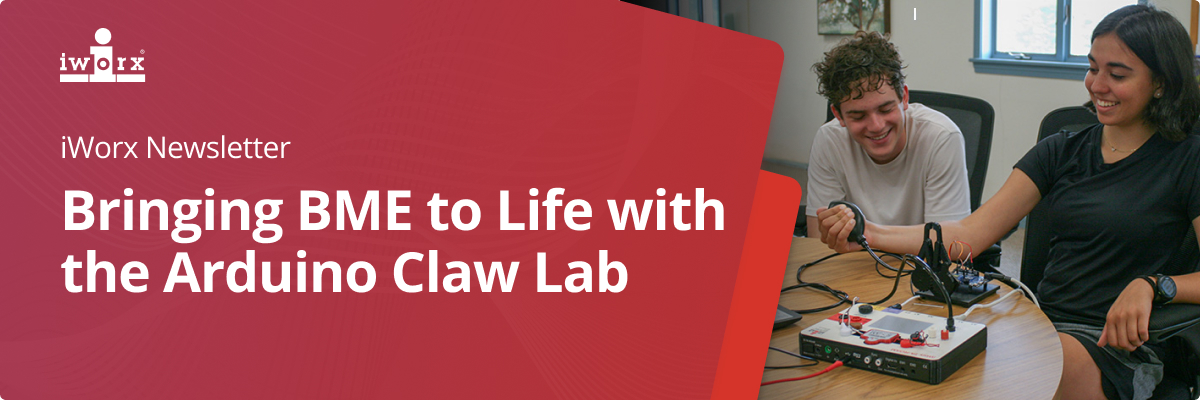
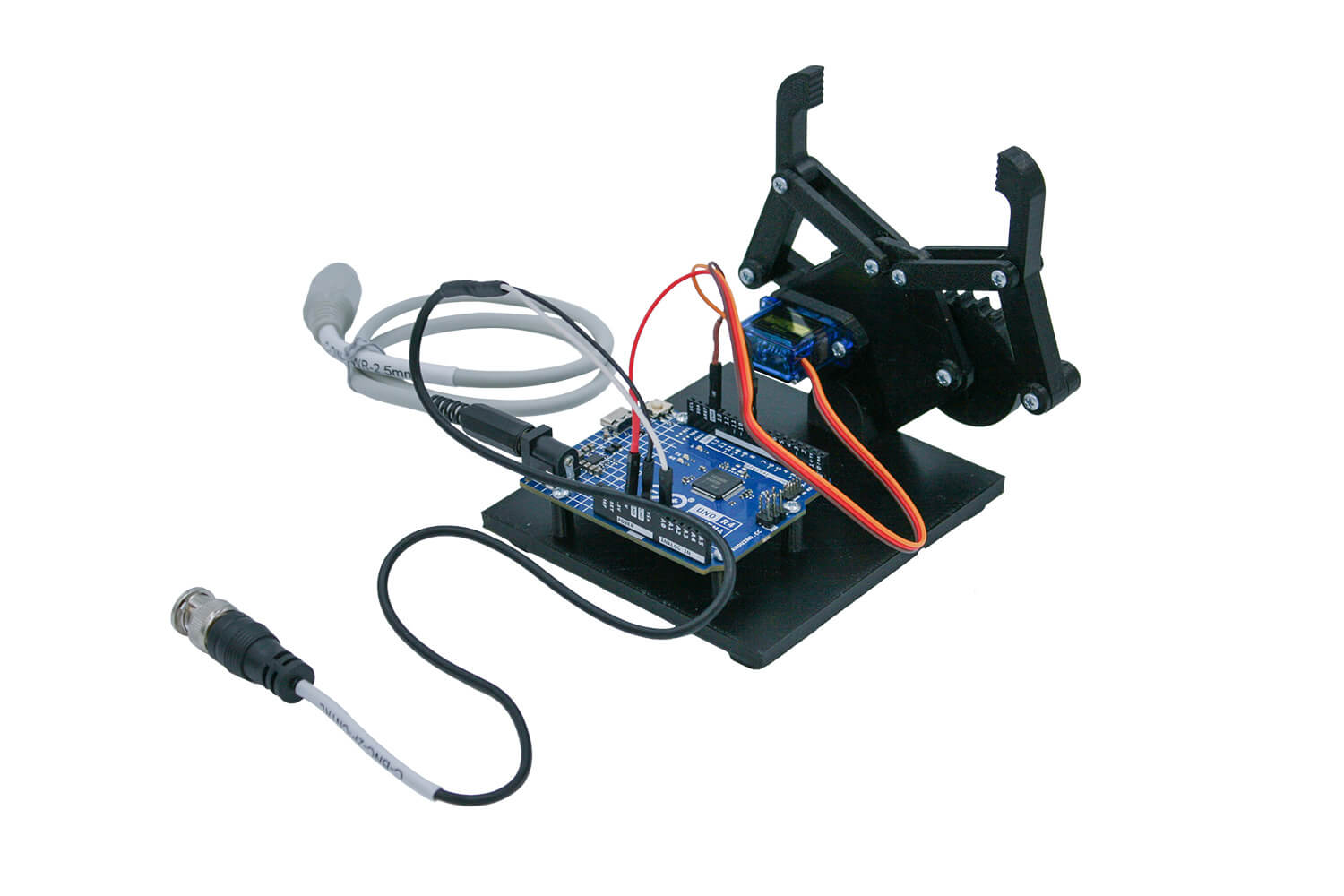
Our Arduino Claw Add-On Set (A-CLAW) answers this question perfectly. This lab takes abstract concepts in signal processing and microcontrollers and packages them into a tangible, high-engagement project.
Inside the Lab: Muscle to Machine
Using the iWorx BioInstrumentation Physiology Kit and LabScribe software, students explore human-machine interfacing in a structured, step-by-step progression.
Students begin by using an FT-220 force bulb transducer. Squeezing the bulb sends an analog voltage signal to the Arduino UNO via the iWorx stimulator output. This maps physical pressure directly to the servo motor, allowing the claw to open and close. The force bulb is replaced with a biopotential recorder. Students place surface EMG electrodes on their own forearms. When they flex their muscles, raw electrical activity from the motor units is captured in real time. Since raw EMG data is too chaotic for simple microcontrollers, students utilize LabScribe to calculate the Root Mean Square (RMS) of the signal and apply a smoothing channel. This turns the raw spike train into a clean, predictable envelope. When the smoothed RMS channel hits a specific high threshold (amplitude), LabScribe commands the hardware to fire a trigger to the Arduino, snapping the prosthetic claw shut.
Once your students master the basic protocol, the Arduino Claw serves as a way to generate other hypotheses for engineering and physiology design:
- Proportional Speed Control: Challenge your students to modify the provided open-source Arduino sketch so that a stronger muscle contraction causes the claw to close faster, mimicking true advanced prosthetics.
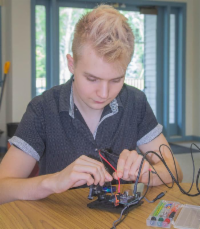
- Hardware Filtering (Breadboarding): Instead of using LabScribe’s software filters, have students use the kit’s solderless breadboard to build an analog operational amplifier (Op-Amp) circuit that smooths the raw signal before it ever reaches the Arduino.
The Arduino Claw is available as a build-it-yourself kit (A-CLAW-KIT) or pre-assembled device, making it a versatile tool for physics, engineering, and quantitative physiology labs alike.
Ready to Elevate Your Biomedical Engineering Labs?
Transform abstract concepts like EMG signal processing, microcontrollers, and prosthetic control into an engaging hands-on learning experience. For a limited time, save 15% on the A-CLAW-KIT and give your students the opportunity to build, program, and control a prosthetic claw using their own muscle activity.
Web Links
For more details about vascular compliance, view the links below.